When Evidence Isn’t Enough: Are Deposit Decisions Losing Their Way?

When Evidence Isn’t Enough: Are Deposit Decisions Losing Their Way?
There is a growing concern across the lettings sector, and it is one we have experienced first-hand.
Tenancy deposit schemes are there to provide a fair and independent resolution when agreement cannot be reached. In principle, that is something we fully support. However, recent decisions are beginning to raise serious questions around how evidence is assessed and whether the balance between landlord and tenant remains fair.
This is not about landlords expecting to succeed in every claim. It is about consistency, clarity, and the correct application of the legal test.
Real Situations We Have Faced
Before looking at the wider issues, it is important to understand the type of decisions that are driving this concern.
- New Windows – Cleaning Refused
During a tenancy, the landlord installed brand new windows.
At check out, the windows were visibly dirty and had not been cleaned to an acceptable standard. A claim was submitted for window cleaning only, simply to return them to a reasonable condition.
This claim was refused.
The reasoning focused on the absence of specific signed confirmation of the condition of the newly installed windows during the tenancy. - New Lino – Damage Not Awarded
In the same property, new lino flooring was installed during the tenancy.
At check out, the lino showed clear damage beyond fair wear and tear. A claim was submitted accordingly.
This was also refused.
The decision relied on:
• no photographs taken at the exact point of installation
• no signed confirmation from the tenant of the condition - Cleaning Dispute – Effort Over Outcome
In another case, a property was not cleaned to the required standard at check out. This was supported by the check out report and photographs.
However, the tenant provided a handwritten invoice stating that cleaning had been carried out.
Despite the lack of supporting detail or photographic evidence, this was accepted, and the landlord’s claim was significantly reduced.
This raises a fundamental question: If the property is not clean, does it matter that someone attempted to clean it?
When Visual Evidence Is Not Enough
A further example highlights the issue even more clearly. Below are the check in and check out images of a door.
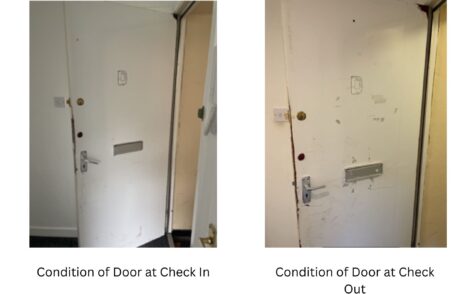
The deterioration is clear, with visible marking and damage that was not present at the start of the tenancy. Yet no meaningful award was made.
Where the Process Is Falling Short
Following the decision, a formal challenge was submitted. The concern was not simply the outcome, but how the decision had been reached.
- Incorrect Evidential Threshold
Under the Tenancy Deposit Schemes (Scotland) Regulations 2011, adjudication is based on the balance of probabilities, not absolute proof.
There is:
- no legal requirement for a tenant to sign confirmation of condition for items installed during a tenancy
- no requirement for a standalone installation record
Yet decisions are increasingly relying on the absence of this type of documentation. This applies a higher evidential threshold than the law requires. - Failure to Draw Reasonable Inference
It has been suggested that just because something has been replaced does not mean it can be assumed to be in good condition.
While correct in isolation, this overlooks the role of reasonable inference.
Where:
- items are clearly different between check in and check out
- no issues were recorded at check in
- and deterioration is evident at check out
…it is entirely reasonable to conclude that: replacement occurred during the tenancy, and those items were installed in a serviceable condition. Refusing to draw any inference from this evidence is not neutrality. It is a failure to properly assess the facts. - Evidence Not Considered Holistically
Adjudication should consider the full picture:
1. check in and check out reports
2. photographic evidence
3. and the logical sequence of events
Instead, decisions are focusing on individual gaps rather than the combined evidential weight.
4. Photographic Evidence Being Undervalued
Photographs form a key part of any inventory. Where images clearly show:
• a good condition at one point
• and deterioration at another
that should be sufficient to establish change during the tenancy. To disregard this in favour of written wording alone undermines the purpose of having a photographic record.
- Incorrect Evidential Threshold
The Core Principle Being Missed
At the centre of many of these decisions is a simple but important point:
A tenant’s obligation is outcome-based, not effort-based. The requirement is to return the property in a comparable condition, allowing for fair wear and tear. It is not enough to show that:
- cleaning was attempted
- or works were carried out
If the outcome at check out does not meet the required standard, the obligation has not been fulfilled.
A Pattern That Cannot Be Ignored
We have challenged a number of decisions where we believed the approach was incorrect. To date, none have been overturned. That raises a broader concern about how effective the review process is in practice.
How Landlords Can Protect Themselves
While the system may feel increasingly difficult to navigate, there are practical steps that can help strengthen your position.
- Keep Detailed Records of Works
- Where items are replaced during a tenancy, retain:
• invoices
• dated photographs at installation
• brief written records of condition
• Use Clear Before and After Evidence - Comparative evidence remains key, but it must be clear and consistent.
- Avoid Informal Documentation
In practice, we are seeing informal or handwritten invoices being accepted as evidence, even where they lack detail or supporting proof. This inconsistency makes it even more important for landlords to rely on clear, professional documentation and strong photographic evidence when presenting a claim.
Set Expectations Early
Tenants should understand from the outset that the property must be returned to the same standard, not simply “cleaned”.
Where Do We Go From Here?
We will continue to challenge decisions where we believe the wrong approach has been taken. However, it is important to be open. Despite well structured challenges, we have not seen decisions overturned.
As a result, we are now:
• reviewing whether to move deposits to an alternative scheme
• considering formal complaints regarding decision making standards
A System That Needs Rebalancing
Deposit schemes play an important role in the sector. When they work well, they provide clarity and fairness.
But fairness depends on:
• applying the correct legal test
• properly assessing evidence
• and drawing reasonable conclusions
At present, that balance does not always feel right. And that is a conversation the industry needs to have.